This post is aimed at a smaller section of you, those already developed in their conditioning, athletes needing to do a lot of sprinting work, whether they be short or long distance athletes, and need to get that extra edge. It is also targeted at people needed some variety in their training. Lets face it, running can get boring, chuck a parachute on the back and you have some serious resistance and a new training stimulus that will not only keep you motivated, but will work you very hard. The fact is that when you are an elite athlete, every second seriously does count. Training methods are adapted to ensure that you get the most out of your body. One method of overload whilst sprinting, which is actually quite hard to do, is the running parachute. This is not necessary for everyone out there, it can provide training benefits in a fun and different way, but mostly it is used as a great way to get an extra edge for those already highly conditioned.
What Is A Running Parachute?
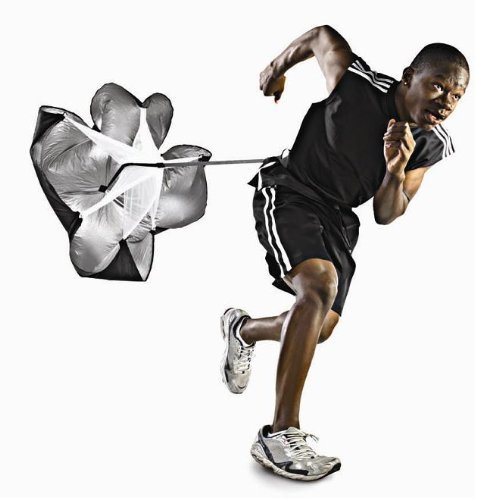
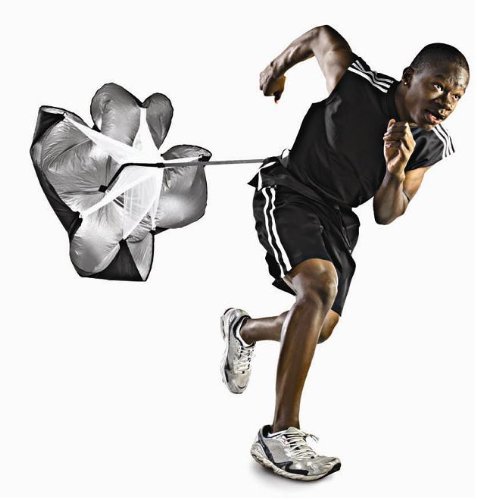
Well, it is a running parachute. I parachute that opens up behind you when you run and provides resistance. It is a popular inclusion in a lot of sprinters training, Because it provides an overload stimulus that usually only running up hills can give you. It attaches via a harness around your waste and when you take up, catches the wind. It will help you to increase both your speed and your strength, because you will work against the resistance provided.
How Does A Running Parachute Work?
It works via the progressive resistance model. The faster you go, the harder it pulls back on you. This is the first indication that it can be used for any level of conditioning. You go super fast, you get super resistance. Either way you will be challenging your body in a new way. You only need to use this parachute in an interval nature, and would not be something that you use all the time. It gives you a great stimulus, but it is not the be all end all. By all means incorporate it in your training, and you will certainly feel the benefits, however it should be used as part of a rounded training plan, and this is where it is most effective.