The push up is one of the oldest exercises in the book, and for good reason. It works. People have used it throughout time to build strength, get a better physique and prove their manliness! The thing is, this exercise is simply one of the best you can do for your shoulder health. You are too advanced for push-ups? Take a step back, read this post and rethink your stance on the old push-up.
Why Push Ups?
Push-ups are one of my favourite exercises, here are push ups benefits:
- Good compound exercise that targets the chest, shoulders and triceps.
- There are many variations and progressions.
- Can help you break through your bench press plateau.
- Gets your abs and core going, think prone holds.
- Uses lots of muscles in the upper body and trunk and consequently you will burn a fair few calories when performing sets of push-ups
- It is an ultimate exercise for shoulder stability.
- Looks pretty good if you can smash out 100!
These are all great reasons to get the push-up back into your training program, but the ultimate and most important reason, is shoulder stability. Shoulders are naturally very mobile joints. To keep your shoulder healthy, impingement and pain free you need to keep them stable. One bone has a lot of control over the stability of your shoulder, and push-ups do a great job at working the muscles that control this bone. The magic bone is your scapula. For those not familiar with anatomy, it’s otherwise known as your shoulder blade.
The Importance Of Scapula Stability
The joint between your humerus (upper arm bone) and your scapula is called the glenohumeral joint. It is what is commonly known as the shoulder joint. As the scapula is half of your shoulder joint, it is pretty important to the health and functionality of this ultra mobile joint. If your scapula control is crap, your shoulder health will be a concern. It directly affects the shoulders ability to stabilise, and you are putting yourself at risk of many injuries if it is not functioning the way it should. Common injuries resulting from poor scapula function and therefore shoulder joint instability can include
- Impingement- something gets stuck in your joint, muscles get inflamed and the joint doesn’t move smoothly, it’s a pretty small space in there and things can get impinged easily. Also known as and can include a pinched nerve in shoulder.
- Rotator Cuff Injuries- Another major stabiliser of the shoulder that could be forced to overwork and you predispose yourself to overuse injuries or acute ones.
- Labrum Tears- This is the cartilage lining your shoulder joint.
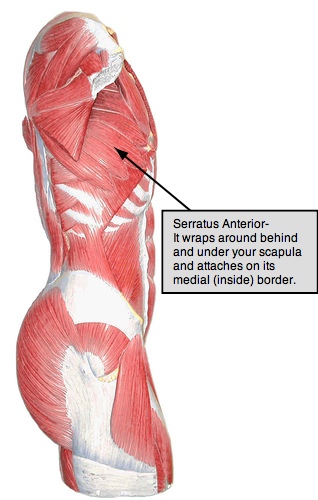
Serratus Anterior Is A Major Unknown Player
Hands up who has actually heard of this muscle? I can assure you that before taking anatomy I had no idea about it whatsoever.
Pic: Euskalanato
If you think about the scapula for a second and where it sits on the body, very few ligaments or structures join it to the rest of your skeleton. Therefore the muscle function around the bone is extremely important to the ability of the scapula to stabilise your shoulder.
Why Is This Muscle So Important?
Bench Press and rowing exercises both provide downward rotation (when you raise your arm it is upward rotation of the scapula, when you lower it, downward) of the scapula. Without training the serratus anterior, we can become ineffective at opposing this movement, which is upward rotation. This is one of the most important push ups muscles. There is a big imbalance, which often can go unnoticed. This is only one part of the beauty of this muscle. What the serratus anterior also does is keep the scapula correctly against the ribcage, basically stabilising it.
Unfortunately the serratus anterior muscle, kind of like the VMO in the knee, is one of the first things to turn off when there are shoulder problems present. We need to keep it active because a healthy serratus will:
- Prevent Impingement- Provides upward rotation, when bench press and rowing exercises both promote downward rotation. We all know that a balanced program is a good program. More downward rotation tendencies and imbalances will mean less mobility and range when trying to put your arm overhead and hence lead to impingement in your shoulder.
- Promote Stability- Keeps the scapula against the ribcage, and stops it from flying out in all directions. A stable scapula means a much more stable shoulder joint. You want this.
Wasn’t This Post About Push-ups?
Yes, yes it was. Although on the surface the bench press and the push-up seem to work the same muscles…chest, shoulder triceps, when you bench press, you don’t activate the serratus anterior. In fact, if you are performing the bench press properly, locking your shoulders, you are actually performing one of the opposing movements, scapula downward rotation. This is the same movement you get during most rowing exercises.
So, not only do push-ups give you great strength benefits, they also activate this highly important, unknown and very underrated muscle. The push-up also involves a variety of other shoulder stabilising muscles that will help your shoulder and body get injury free and strong.
Want More or Less Weight?
We like to bench because we are lifting big weights. The strong guys out there may find they can do way too many reps. If you are starting out with strength training or are new to push-ups, you may find that they are simply too hard. The great news is that there are many progressions and variations to suit all levels.
Need Less Weight?
- Do them on a bench or an elevated surface. Put your hands up on a bench (whatever height you need, it can be very high to start), and as you get stronger, slowly come down to the floor.
- Get on your knees and do some push-ups. It is important that you try to keep the correct posture during these; they tend to make you want to slouch. Do these until you can progress to on your feet.
Need More Weight?
- Elevated Feet is one of the first and most simple progressions you can make. Put your feet up on a bench and away you go.
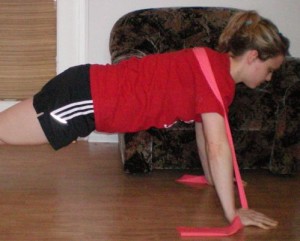
- Resistance Bands are another great progression. Place the ends of the bands underneath your hand, and run them over the top of your upper back. Check out the pic below. Shorten or lengthen the band for more or less resistance.
- One Armed push-ups are a killer. They are great for shoulder stability and if you can do them you are doing all right!
- Add weight to your back
- Chains- Chuck them over your back.
- Plate- Get someone to place a plate on your upper back and away you go.
- Backpack- Put a backpack with some weights in it if you aren’t comfortable with the plate on your back
- Vest- Get a weighted vest and wear it during push-ups
Other Progressions
- Stability Ball push-ups have been shown to increase the activation of your triceps as a shoulder stabiliser and your abs. But not the serratus anterior. This is another way to perform the push-up and is a good variation for shoulder rehab.
- Explode out of your push-ups. Speed is a great way to chance up an exercise. If you are pretty efficient with your push-ups, try some explosive ones where you are basically jumping off the ground with your hands.
- After Bench Press add a set of push-ups. It’s a good overload and a way to help get your bench press better.
Are You Missing Out?
Push-ups are great for strength and shoulder health and a convenient exercise you can do at home. If you have a few shoulder problems, sub the push-up in occasionally and feel the benefits of a stable shoulder. If you are simply conscious about injury prevention, doing the odd set of push-ups will do wonders. There is no need to cut out your bench press and totally rely on them. Keep in mind that shoulder stability is one of the keys to safe and effective lifting, and the good old push-up will really help to improve it.
joe says
hey good post, what do you think of just doing random sets throughout the day? i think its called greasing the groove, i don’t know if thats a proper thing but i heard someone call it that.
Renee Wise says
Thank you, thank you, thank you! I am going to get started today! I’m in PT for my shoulder and I have become so weak in this area. I will of course talk to the PT about it before I dive in but I’m sure it will be ok as long as it doesn’t hurt. I’m loving your sight. Could you talk about the titlted pelvis and exercises you could perform to help correct the problem.
Lauren says
Yep it’s called greasing the groove. People use it commonly to increase their chin up ability. My take on it, generally, the more you do something, the better you will get. But, if you are going to do push ups randomly throughout the day, then do some chin ups too!
I prefer the structured environment, where you can control what you are doing, the best results from push ups will come if you are doing proper sets of them. This is where you will get the most gains. However, greasing the groove for body weight stuff is very effective. Depends on your time and motivations.
Lauren says
@ Renee
No problems! I glad you like the site. The key here is for you to go slowly. Push ups will help you, but start on the lowest and easiest progression. Might even be better to start just holding that position on a raised bench. Good idea to go and speak to your trainer.
I have put the pelvis tilt article on my list of things to do. Keep a look out for it!
Cheers.
joe says
am doing the 5×5 routine, but i want my push ups to be good at the same time, thats why i thought it may work using push ups.
thanks for the help
Lauren says
No problems joe. Just remember if you want to do extra stuff, you need t0 make sure it fits into your program and you balance it out.
Cheers.
tanya says
Thanks for reminding me about this. There was a time when I could barely do 1 – and for those people out there like me, I just started doing as many as I could in the morning as soon as I got out of bed and not even part of any workout routine. I improved dramatically.
Great blog too :0)
Lauren says
That will definitely get you better at them! Cheers for the kind words.
joe says
i see, do you mean like push and pull moves. if i do a set of ten push ups, put a set of pull ups in too?
Josh says
I never thought of wearing a backpack. What an easy way to make it more difficult. Thanks! -Josh
Harsh says
Great post…
Another variation for greater shoulder stability is iso-pushup hold…
http://www.t-nation.com/article/most_recent/exercise_of_the_week_the_iso_pushup&cr=
Cecily T says
Could you maybe do a follow-up post about the proper positioning of your hands and elbows when you do a push-up? And how changing these affects different muscles? I’ve read stuff suggesting that you put your hands together with thumbs and fingertips touching, but also that the only ‘right’ way to do a push-up is with your hands planted directly below your shoulders. A pilates push-up and some yoga poses (from workout tapes) show that you keep your elbows in, but again, I’ve seen that you should have them ‘boxed out’ to have proper form.
Thanks!
Lauren says
@ Josh
Yep it’s a very simple solution. Looks a little strange but it works.
@ Harsh
Cheers, iso push up hold is probably the very first progression when you are trying to regain shoulder stability. Thanks for pointing it out, I should have included it.
@ Cecily
I’ll follow that up for you now! The only real change you get with altering the width of your hands is more triceps stress when they are close together. Same deal as with my bench press post, when you go wide, it’s just a little bit yucky for your shoulder. I can’t say exactly what the right way is, but I wouldn’t recommend push ups with different hand variations. i.e your fingers pointing in different directions. Vary the width of your hands, or the way you do the push up (weight etc), but the normal hand position is best for your shoulder and for results.
You mentioned planted directly below your shoulders, I would think that you would want to be slightly wider than that for an ‘optimal’ pushup. However once again, it’s all about the individual!
Oh and elbows in, is basically close rip, you’ll find you can’t get your elbows out when you are in a closer grip push up.
Hope that helps!
alex says
great post! people often underrate the value of push-ups and I do not know why. in my new contest you can win some push-up bars so check it out http://aitank.com/2008/03/03/a-contest-woot-for-free-stuff/
Abhishek says
Great article! Not solely because of the anatomical details and explaination provided, but because of a simple reason… reminds people to go back to basics and do the simple things right ( which many of us overlook )
Posture Exercises says
Some local radio guys here in my area are trying to do 10 000 push ups each in the month of March. I’m curious to hear what they have to say after they finish, if they finish.
Jason says
I liked this article also! I also wanted to make a second vote for writing the pelvis-tilt article – anxiously awaiting it!
Jason
Radovan III says
Push ups are the best, iv been doing 60/70 per day for the last 3 months and iv gained 3 kilos of (at least I think) muscle on my shoulders and upper back. Iv never felt better…
Simon Boyce says
If you really want to target the serratus anterior you can do scap push ups. James Wilson includes these in his mtb strength training program (mtbstrengthcoach.com), and there’s a similar move used in Pilates. You get into a push up position and then push your shoulders/upper back back away from the floor, bringing your shoulder blades together and then pushing them apart.
Chris says
Push ups are well worth the effort, even though they may be intimidating at first.
Patrick says
You must be a fantastic trainer, because your blog is really informative.
Rocky says
I have a question, I’ve read over the article and comments and didn’t find the answer! Sorry if I missed it, is it OK to do pushups everyday? Like doing morning and/or evening sets as a daily routine?
Ed Smith, Palm Springs, CA says
One great authority on push-ups, Charles Atlas, says that one should place the hands approximately 18″ apart. I am sure this could vary by an inch or two at the most, depending on the width of one’s shoulders(from joint to joint). One probably shouldn’t have the hands out of this range. Also, Charles Atlas states that it is best to have the hands elevated on something(such as a pair of small chairs) to increase the range of motion on the lower end of the push-up by allowing you to dip down a little further. By following Charles Atlas’ workout I put on 18 pounds of muscle in the first 13 weeks. I’m 6′ 2″, and in this time I went from 160lbs to 178lbs. I can’t button the top button anymore on a few of my shirts because of muscle gain. I think it’s safe to say his methods are as good today as they ever were.
exercise lose weight says
I just started doing as many as I could in the morning as soon as I got out of bed and not even part of any workout routine. I improved dramatically.
hoodia says
Typically women do not have strong upper bodies. Unfortunately this lack of strength can lead to injury and loss of ability. Many common movements such as lifting heavy objects or placing items over the head –- require strong upper body muscles.
darren says
Woooow!!! Great article!!! I have been doing push ups lately and have just recently graduated to the weighted vest (30 lbs). I will do at least 60, maybe 100 tonight; you have me so motivated. I am in great shape,but I have never been that good at the bench press. I am hoping this will help. You give me the impression of someone who truly cares about the health and progression of others. Please keep up the good work. I am impressed. Thank you
Darren
Jay says
great work!
certainly helpful to newcomers like me.
Neeraj says
Very useful. Would be great if videos can be added.
Weight Loss In London says
Hiya, I really desire to give a massive praise for the good facts that you have laid out here on this web page. I would absolutely return to your blog for more reviews rather soon.
Forward head Posture says
Yes, push up is definitely a great exercise, the simplest way to to get fit and to look good physically.
Blades says
I think’s it’s heathy because it’s for your body so you can have a heathier body and eat heathy because if you don’t have a heathy body you all is a bad body and that’s bad for your body so do push-ups all day to have a heathy body is a good thing so do push-ups every day.
Laura says
Awesome! Thanks for writing this!
Push ups says
We’re a group of volunteers and starting a brand new scheme in our community. Your site provided us with helpful info to work on. You’ve
done a formidable process and our whole group will be grateful to you.
Aks says
Hey Lauren,
I am male and have winged scapula (no injury, it’s since birth) and creaking- but without any pain- shoulder joints (maybe this is a manifestation of winged scapula). I stopped doing bench press and rowing after reading your article and it seems like my shoulder joints are thanking me for it.
So keeping your suggestions in mind, I started doing two-arm and subsequently one-arm pushups (and also pushup iso holds, which I guess is not mentioned in the article) and WOW, my shoulders have never felt better.
I would really appreciate your opinion on the below exercises:
-> PLANCHE PUSHUP: If pushups are good, I’d assume this would be good as well.
-> FRONT LEVER: I need a PULL exercise to work the antagonistic muscles. I had to stop doing rows. Two-arm bodyweight pullups are no more challenging and I am not sure if one-arm pullups are good for the shoulders. I’d totally prefer front lever rather than weighted two-arm pullups.
-> BARBELL HACK SQUAT (not machine): youtube.com/watch?v=EdtaJRBqwes -I’ve tried a lot of deadlift and squat barbell variations and while they have been really beneficial for my back and overall body, I think they did make my shoulder joints creakier and so I have stopped doing them. Barbell hack squat, on the other hand, actually feels somewhat similar to pushups (for my shoulder joints and Serratus Anterior). Maybe it’s just psychological as I liked the movement and so I want to check with you.
So the basic criteria is that the exercises should help work the Serratus Anterior (or at least be neutral to it) and not aggravate the condition further (winged scapula, poor scapula function, shoulder joint instability, creaking shoulders, etc.). I’d rather skip an exercise than keep any doubts.
Do comment on the above 3 exercises that more or less work the entire body – upper body push, upper body pull, and lower body. As an alternative to working out, I started dancing regularly for fun and general conditioning and to give my joints a break. But I’d still love to do a MINIMUM set of exercises as mentioned above.
Regards,
Aks
Lauren says
I’m sorry I didn’t see this comment earlier.
Honestly, my opinion is trial and error.
You have made steps to help your shoulder and you possibly don’t need to get rid of the bench and rowing completely, if you like them you can keep doing them, just keep an eye on your shoulders and continue with the exercises that helped.
The first two are pretty advanced bw exercises, if you can do them, you are going to work your whole body and get great results. If your shoulder hurts, stop.
I don’t like the hack squat personally I think it ends up straining your back quite a lot, but if you have good mobility and it feels good, it’s ok.