
As a general rule, when working, lifting and exercising we are stressing the same muscles and movements. This repeat stress can lead to overworked muscles and consequently tightness and trigger points. I don’t need to go through this again though, it’s all covered in Part 1. The lower body has many common trigger points. Most of us sit all day long, and then go to the gym and do the same things day in day out. We are going to look at some of the more common places where almost everyone is tight.
What You Should Know Before
- It will be painful… but, it shouldn’t kill you. If it doesn’t feel like a good pain, stop. Maybe you have an injury.
- Go slowly. Work up and down the muscle at a slow pace, and stop on any tender points. These may be trigger points.
- Work up and down through each muscle about 5 times or hold and move around on an area for 30 seconds at a time. Do each muscle a couple of times, it’s not important how much you do it, you will know what you need once you start.
- When you reach a trigger point it will be a pretty deep pain you feel. This is OK, grit your teeth and stay on it.
- If it is a trigger point, as you hold the ball on the spot you will feel the initial shock of pain diminish.
- You may also feel referral pain as we discussed in Part 1. Don’t stress, this is normal and means you have hit a spot.
- When you are on an area, work around, test it out. Trigger points are usually in certain areas, but don’t be afraid to move around on the ball and find where yours are.
Remember, even if you don’t find any trigger points or specifically release them, you will find that a deep tissue massage does wonders for how your muscles and fascia feel. Recovery is important, and this is one of the steps to feeling top notch. If you don’t actually find trigger points, you will see that these areas are very tight in most people and simply need loosening anyway. Give them a crack, work slowly and grit your teeth!
Note: Although I said everyone has a tennis ball…I don’t. I have a massage ball which is basically the same size, weight and gives the same pressure. It’s red, and I am wearing a red t-shirt…sorry. Oh and excuse my white pins, I live in Europe in the winter, and then go back to Australia for the winter.
I have had a lot of emails asking about the massage ball that I am using, like I said a tennis ball works great, but you can get the exact ball I am using here on amazon. There are a few other sizes too, check them out here: Spiky Massage Ball

1. The Foot
OK, so I am going to start in a place that doesn’t have any trigger points. Intelligent eh? I simply had to include this one in a tennis ball post because this is the best way to get your foot loose. I will discuss this more in an upcoming series on fascia, however under your foot is your plantar fascia. How this functions directly affects the rest of your leg. Most of us are tight here, and we are going to start from the bottom and work up.
How To:
Stand on one leg, place the ball under the foot and then let your body weight onto the other leg. Roll around on each foot for about 30 seconds. Get the whole foot, under the arch, and hold on any tighter areas.

2. The Peroneals
These are tight in quite a few people. Tight peroneals can lead to knee pain. Let’s get them loose.
How To:
Lay on your side, place the ball under the outer side of your lower leg. Roll up and down slowly, and stop whenever you feel a tender spot. If you don’t feel any, thats great, keep rolling.

3. The Calves
Your gastrocnemius and soleus are bound to have trigger points. Most of them you wont even know about until you find them.
How To:
Start on your bum, raise yourself a little (the more of your body that is raised off the ground, the more pressure you can put through the ball…) and place the ball underneath your calves. Roll right from the achillies up to under the knee. Slowly. Stop on any tender points and hold. As the calf is pretty wide, you might need to try a few lines, i.e medial, middle and lateral. See how you go.
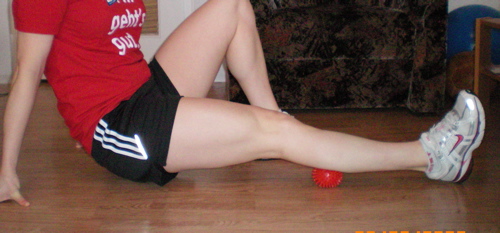
4. The ITB
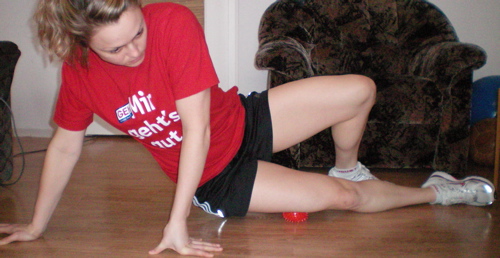
This tight band of fascia along the side of your leg is almost always tight, and can often have trigger points. You may find in this case the tennis ball serves better for a simple fascia release, however, up closer to your hip there are some trigger points.
How To:
Roll on the tennis ball, from the knee right up to the hip. If you come across a sore point stop and hold. The ITB is often very tight, and rolling on it with a tennis ball will be painful. Personally, I often get on the tennis ball for a more hardcore stretch than the foam roller, but rarely find trigger points.
5. The TFL
This baby is often tight in people who are sitting down a lot. It gets put into a shortened position and over time will adjust and stay in that shortened state.
How To:
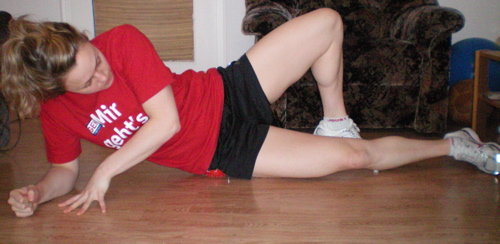
Locate the TFL first. It is between your ITB and the top of your hip bone, slightly more anterior. Put the tennis ball underneath it, put as much body weight onto it as you can handle and begin searching for the dreaded trigger points. This thing is almost always tight in people, and you will feel quite a lot of pain and release even if you don’t find trigger points.
6. The Glute Med
How To:
Similar area to the TFL, but slightly more posterior. A lot of people tend to be tighter up the top of the glute med, where it attaches. Search around and figure your body out for yourself!
7. The Hip Rotators
You may or may not have heard of a little, painful and annoying muscle called the piriformis. This is one of a few hip rotators that you will be working through, but seems to be the one that causes people the most problems.
How To:
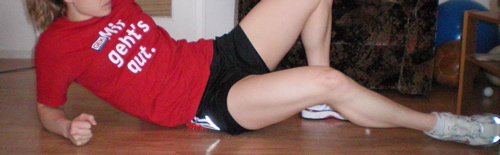
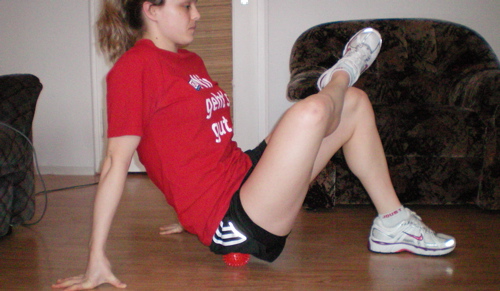
Basically sit on the ball in the meat of your arse like I have shown you in the picture. Move around a lot and I will guarantee you will find the piriformis and its friends. This thing is small, tight and angry. When you find it you may get pain shooting down your leg. Hold it there, you can do it, and you will feel enormous benefits from this one. If the pain is too sharp, straighten your leg out and sit in he same spot, this means the hip rotators aren’t on as much stretch. The result isn’t as great but you can work into it. Suck it up and cop some pain!
What You Should Know After
- After the session stretch the areas you found trigger points in.
- You may be bruised, probably not, but if you are doing it for the first time this could be a side effect.
- Again, for first timers, you can be a little sore after it. It is pretty localized work.
Now that your lower body is sufficiently sore and angry at you for poking around, keep at it. These things don’t happen over night. Most of us get trigger points from repeated movement patterns or being in the same position for lengths of time (i.e sitting down all day at work). The same goes the other way. It will take time to release everything, but I guarantee after one session with the tennis ball, you will feel the difference.
If you want more information on using a tennis ball to release your whole body, then check out my Self Massage Guide. It will teach you how to discover your body with a tennis ball and a foam roller and ensure that you find all your points. What you see here is just scratching the surface of what you can do to help your pain.
Now go and get your lower body in good nick and get ready for some Upper Body pain in part 3…coming soon.
Jason says
Lauren-
Great article, I’m going to start doing some of these to work out the kinks. How often do you recommend doing these exercises for someone who hasn’t noticed any specific pains… as a preventative exercise for someone who wants to do enough for simple injury avoidance?
Thanks.
Lauren says
Hey Jason,
I think once a week is enough for pure prevention reasons. If you are doing regular stretching and foam rolling, then this deep work once a week is more than enough. However, you might find you have some tight spots that you were unaware of, get into these a little more often. There is no specific rule, however I find if I sit down and do a big session with the tennis ball on the weekend I am feeling a lot better for most of the week.
Do it once and see how you go, I will be surprised if you don’t find any tight spots, but take it as it comes. if you are tighter, do it more often, if not, once a week and you will be laughing your way to an injury free body!
Cheers.
Cindy says
Great post about trigger points. I look forward to giving these a try.
Lauren says
Thanks Cindy, good luck!
Richard says
Hi Lauren,
This is a great article..but I have one question. What is the ball you are using? My tennis balls often get deflated, or slip out from under my legs..
Thanks!
Richard
Heleno Ferraz says
Wow great article and it has changed my life too!! 3 years ago i developed sciatica. It got sorted out, but a few months later i developed a really bad lower back pain, my hips were very very tight too, a few month later my hamstrings went , terribel pain. could not bend . Saw lots of professional , did lots of tests and all came up with 1 diagnosis – ageing !! so having tried everything , i decided to accept that at the age of 39 i was ageing !! ( I am a very active person , gym , cycle to work, swim ) then 5 days ago I mentioned my plight to friend and he said get a tennis ball! I have been using it all day , at home in the morning , at work when i have a spare moment and evening, and do you know what. I don’t think I am ageing. I regained strength in my legs, my hamstrings are 99% my back is 85% and my brain is 100%.
I m just worried that i might become addicted on tennis ball.
It has been a great discovery , you webpage is the best so far and i have been searching the net all nite for more info and not found any rival.
Thank you so much.
Heleno
Lauren says
Hey heleno
It’s great to hear stories like yours thankyou for your feedback. It’s been a while between posts, I’ll try and get some more stuff up soon!
Trigger points can hamper people and they don’t even know, some simply self soft tissue work always goes a long way.
Cheers!
Ben says
I am using this as a general guide for soft tissue work. I have Clair Davies book on the subject, but I just don’t get some of his descriptions. These are much simpler to understand, and WOW do some of these hurt.
Steve says
Hi Lauren –
I’m so glad I found your website ! This is great advice , and I’ll try this technique in a little while . But before I do , I want to make sure I have the right trigger point for my pain . I have pain on the outside of my lower right leg , and it only occurs when I’m standing and putting any pressure on it and especially when I attempt to walk any distance at all , and it sometimes gets pretty bad . I do 45 mins on the elliptical 5x’s a week and I’m physically fit . Also , it’s weird because when I’m on the elliptical there’s no pain at all , but when I get off it comes back .
Anyway , I’ve tried stretching exercises for my piriformis muscle and other self treatment , but this looks like a winner ! Do you know where the trigger point is for my particular problem ??
Thank you so much !!
Steve
Lauren says
Your piriformis is pretty small so just do like in the pic and mvoe around a but, I promise you will find the spot very easily!
kimberly says
Great stretching advice! I did a six hour strenous hike yesterday and suffered knee pain on the downhill descent. Iced and ibuprofen last night, tennis ball stretching this morning and now I am almost 100 percent! I recommend these tennis ball exercises for anyone who runs, bikes and hikes!
Lauren says
Glad it helped!
daniel ives says
hey great articles:)
i am doing the stretch (The Hip Rotators) where your leg goes over your knee and the tennis ball is underneath… i have been having many troubles in the right lower side of my back/hip. I play table tennis and when i do a forehand a lot of pressure goes through the hip. WHen i put the tennis ball there immediately it is so painful beyond belief and i duno if this is good pain or not… my hips there i think are sooooo tight becuase i have had this pain for a few years… i was wondering what you thought about this:)?? also i straighten my leg out to ease the pain but i cant feel the pain when i do this.. i need to put my right leg acroos my left knee like in the picture.. thanks and if you could email me this would be nice… thanks:) dan
Lauren says
I think you have some tight muscles and trigger points! Persist with the tennis ball, I know it can help you out a lot.
Leslie Henry says
Thank you for a well-written, very helpful post. I am a runner who just started seeing a physical therapist; your pictures and instructions are an ideal complement to the PT sessions. Last night I did the tennis ball release on my outer thighs and …Yikes! Ouch! Guess I really needed it! Thanks again and wishing you the best.
Lauren says
awesome love to help!
SAID says
Great thanks to you Lauren
Really very useful information I found in this website and easy to be understood. I m a physiotherapist I and using this technique of tennis ball which been of great effects on my patients
Again accept my thanks & regards.
Rick says
Thanks Lauren.
A friend of mine has severe back pain and swears by using a tennis ball as an aid to exercising. His physio apparently got him onto it. I will pass this on to him.
Rick.
Lauren says
Great let me know if it helps him.
ASAJ says
Thank you, thank you, thank you.
Viktor says
Hi Lauren,
I wanted to know of your thoughts on how long before the supposed pain caused by trigger points should go away? Also, on how often I should do this soft tissue work?
I have been experiencing pain in my right knee for a few weeks now, and it has also started clicking when I am walking – something that it has never done before.
Thanks for a great article, just a suggestion; try rolling your calves over a wooden rolling pin – the pain is A LOT more for me than with a tennis ball.
No pain, no gain, right?
LOL,
Thanks,
Lauren says
Basically until the trigger point is released.
Absolutely no pain no gain, wooden rolling pin is just like a torture foam roller.
Nic Quick says
Whatcha Mate. OK I just had deep pain almost everywhere. I think my ITB needs to be surgically removed-LOL !!! Hell from knee to hip! Foot, peroneals and calf – many spot but not full length like ITB. Its a funny kind of pain in that it did seem therapeutic-but intense(like I just beat my self up). Tonight my legs feel like they are glowing- or have been turned back on. I’m a bit concerned that I have so many painful spots. I just turned 58 and work on buildings-attics,tight crawl spaces on my kees a lot(with pads). My right knee is popping and cracking a lot and pain when I squat. I had PRP(white blood cell) therapy with no lasting result after 1 1/2 months. My legs feel better after my initial TBT(Tennis Ball Torture). So tell me do you think I’m over doing it – or just have an older painful body- or what………….? I’m pretty sure I’m extremely grateful to you !! Hopefully I’m not paralized in the morning. How often can I do this – I feel like doing it again tomorrow ? Seriously, I really appreciate this great info and presentation-really beneficial !!! Nic Quick ~;D
Lauren says
As much as you want 🙂
Sam says
Hi Lauren,
My knees where so painful and cracking for quite some time. After I read your technique using the tennis ball, I feel 100% better. Will add this to my daily exercise regiment. zthanks so much.
Jeremy says
Hey I just recently stumbled across this site. I just wanted to say thanks for all this awesome information! I’ve been having some bad knee pain when squatting during my workouts (I do Mehdi’s Stronglifts 5×5 program, which is how I found your site). Always had bad hips, something that even affected me during my competitive swimming career, but the exercises, stretches, and other info posted here has helped me tremendously!
Lauren says
Awesome very glad to help 🙂
Lambros says
Thank You for this. I just did my lower body and i’m onto the upper body and it feels great. I have a tip for getting the muscles on either side of the tibia. The same way you put two tennis balls in a sock for the erectors, I did that and tied the end of the sock so the balls stayed close together. The tibia fits nicely in the groove of the balls and provides stability when working the muscles. Hopefully that helps someone out there.
Lauren says
Thanks Lambros!!
Marie-Paule says
You are a miracle worker! These exercises definitely work!! Why don’t doctors tell you about this rather than prescribe anti pain medication!!! Have purchased Clair Davies workbook which is very informational but it is your demonstration photos that make it all so much more understandable and practical! Thank-you sooooooo much!
Lauren says
Happy to help!