 Protein is essential in your diet for muscle growth, repair and many basic bodily functions. For strength trainers and exercisers it is even more important. Without the correct protein intake, you are significantly harming your chance at getting the most gains out of your workout. Nutrition is a big part of your success when exercising and on a body-changing plan; protein is essential to those goals. You know why, how much, and when you should eat protein, but do you know where to get it…naturally?
The Low-down on Protein Sources
Protein sources are classified into two groups.
- Complete proteins contain all the essential amino acids.
- Incomplete proteins are lacking one or more of the essential amino acids.
The 8 essential amino acids are:
- Isoleucine
- Leucine
- Lysine
- Methionine
- Phenylalanine
- Threonine
- Tryptophan
- Valine
Essential amino acids are crucial to muscle building. The body can synthesize all the non-essential amino acids. However the essential amino acids cannot, and must be provided by the diet. How many essential amino acids are in a protein source is important because to grow muscle you need to have them all available at the same time. If even one is lacking tissue growth will be much less efficient.
Animal Sources
Protein that comes from animals gives you all the essential amino acids in one go. The big problem most people face here is that animal proteins can often contain massive amounts of saturated fats. There is very little point getting all your essential amino acids from a dirty take away hamburger. You might get your amino acids, but you are going to get a lot of other crap as well. The good news is that there are many lean sources of good quality animal protein that you should be chowing down on daily. Here is a list of some high quality complete protein sources.
- Chicken & Turkey
- Eggs
- Fish
- Lean Red Meats
- Non-fat/ Low Fat Dairy
Plant Sources
If you are a vegetarian you can still get your necessary protein. It just becomes a little more complicated. Plant proteins are incomplete proteins; they do not contain all the essential amino acids. You need to mix and match. It isn’t necessary to actually get these in your body in the one meal, just over the course of the day. You can get protein from many plant sources such as, legumes, grains, vegetables, nuts and seeds, and soy. Keep in mind if you still eat dairy products such as milk and cheese, then you will be able to get all your essential amino acids without having to mix and match.
Here is a list from bodybuilding.com of complimentary sources of protein for vegetarians. I.e. you need to eat one from each list to get a full count of amino acids.
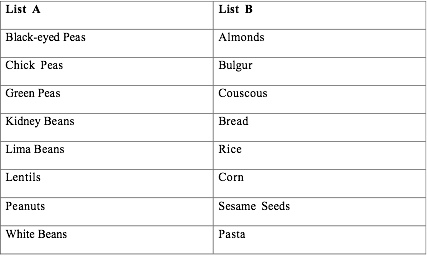
Grains contain a lot of methionine but not much lysine. Many legumes contain a lot of lysine, but not much methionine. Therefore, if you combine both of these foods you get a meal that is a complete source of protein.
The Truth About Soy…Well Not Really
This is a hot topic. Soy as a very high protein count, gives you the full score of essential amino acids, and seems a good substitute for vegetarians, however there is some debate on its effect on testosterone levels and thus, muscle building capacity.
Upside Of Soy
- A plant source that is a complete protein, it contains all the essential amino acids.
- Reported to lower bad cholesterol
- Cheap source of protein
- Contains isoflavones, which may reduce the risk of arteriosclerosis and increase bone retention
- Possible increase in thyroid hormone output, which is a hormone that can help break down fat and carbohydrate, but stimulate protein synthesis if enough calories are eaten.
Downside Of Soy
- Low Biological Value score of 74. That represents the percentage of protein absorbed that your body can use for muscle growth and repair.
- Contains factors that block the digestion and absorption of some nutrients.
- Soy is rich in estrogenic compounds. For someone trying to build muscle a change in the estrogen/ testosterone ratio can lead to increased body fat and may interfere with muscle development.
Leaves you with a tough decision right? Well firstly, most manufacturers take out the factors that block nutrients, so that isn’t a problem. Reading my above pro and cons, you will notice that most stuff is a maybe, or a possibly, or a reported. There are pros and cons to eating soy. The biggest two that are relevant to the body builder or someone wanting to gain muscle and shed fat are the increase in thyroid hormones, and the estrogen effect. One is a big plus, and one is a big negative. My take, everything is OK in moderation. You aren’t going to grow boobs if you eat some soy, but you aren’t going to be a lean machine if you overload on it either. I wouldn’t make soy your only source of protein, especially if you are male. But if you are vegetarian, soy could be a great substitution for you. Just be aware of the pros and cons.
Here is a small table I have put together of protein values of certain foods.
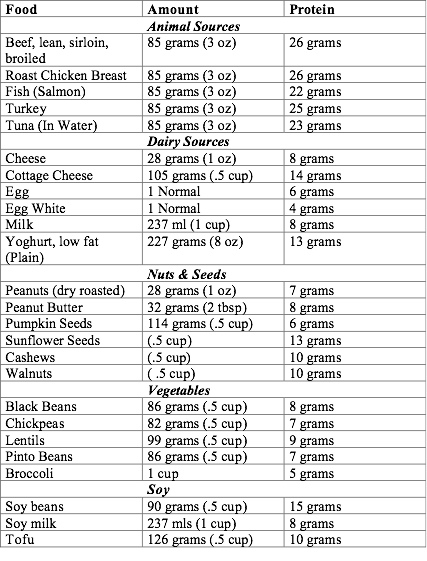
This table was made from various sources over the net
Final Words
Once again these aren’t my final words. There is an upcoming post on protein supplementation. Till then, eat some protein, natural is the best way!
Jason says
The list of “A” and “B” protein sources is very useful. I know that in my own diet, I get more B than A and could probably even it out a bit.
Susan says
Really great info., Lauren! I’m trying to incorporate more protein in my diet, so it was helpful to read your post.
Lauren says
@ Jason
I think quite a lot of people would get more A than B. If you eat meat though it’s probably not such a big problem.
@ Susan
Thanks for the kind words!
Philip says
Good information here, Lauren. For the vegetarian especially, it’s important to combine protein sources thoughtfully. You’ve shed some light on that.
Where might one find more info on the biological values of sources of protein other than soy?
Lauren says
Hey Philip
Here is a site with a few values that might be helpful.
http://www.bodybuildingpro.com/proteinrating.html
Thomas says
It’s sad to see the continued spear of the protein combining myth with regards to vegetarian diets (I am NOT a vegetarian, by the way, I just have many friends who are and have paid attention to this information). You can see here, here and here for yourself. Yes, as always, it’s wise to eat a variety of foods and get your protein from multiple sources, but it’s not essential to combine them in a single meal to get your protein.
Lauren says
@ Thomas
You are right. You DO NOT need to eat these in the same meal to get the full count. Over the day…week…simply balance them out. It’s not important to get them in at the same meal. Thanks for pointing it out, something I should have added. However, keep in mind this site is aimed more at strength trainers, and people trying to build muscle. You want to build muscle more efficiently as a vegetarian, then it is worth paying attention to this. The myth isn’t the fact that each of these sources don’t contain the full count of amino acids, because they simply don’t, and to build muscle you do need to somehow eventually get the full count of essential amino acids. The ‘myth’ is that you MUST eat meat or you will not get the full count, and you MUST eat each source in the same meal. Both are not true. Again, it’s the absolute statements that ruin the fitness industry.
Cheers.
MizFit says
man, back in the DAY I competed in bodybuilding (natural :)) and burned OUT on canned chicken—–but Id totally forgotten about it now (yeah the competition but I mean the chicken here).
might have to revisit that for FASTFAST protein on the go!
MizFit
sherielle says
Soy is not a good protein source for those with low thyroid function problems.”Researchers have identified that the isoflavones in soy act as potent anti-thyroid agents, and are capable of suppressing thyroid function, and causing or worsening hypothyroidism. Soy is a phytoestrogen, and therefore acts in the body much like a hormone, so it’s no surprise that it interacts with the delicate balance of the thyroid’s hormonal systems.”
“Isoflavones belong to the flavonoid or bioflavonoid family of chemicals, and are considered endocrine disruptors — plants or other products that act as hormones, disrupting the endocrine system, and in some cases, this disruption involves acting as an anti-thyroid agent.”
http://www.thyroid-info.com/articles/soydangers.htm
so please do some reading up and learn the pros and cons to soy if you have thyroid problems.
Lauren says
@ Sherielle
Thanks for pointing that out. I knew that it affected thyroid function, and it isn’t totally clear which way just yet, but never connected it as a problem for people with thyroid issues.
Cheers.
Awake In Rochester says
Wow! I could have used that information when I was trying to be a vegetarian. I was eating a lot of rice and beans to get complete protein. So you can eat milk products plus something in either column A OR B, and it will be a complete protein? I had no idea.
Lauren says
@ Awake in Rochester
Milk is a complete protein, as are all dairy products
Cheers
iffy says
got good information from here
thanks a ton
Laila says
good information from now on i know what to eat so i can have protein in my diet…..thanks