If you want to know how to release your fascia, get rid of your pain and help your muscles and joints then you should check out my Ultimate Self Massage Guide. It shows you how to use a tennis ball and foam roller to combat your pain at home.
Things hurt sometimes. You get pains and aches. It’s ok, because generally you can fix it. However, sometimes the issue may not be so simple. Got hamstring problems? How about tight calves? Get constant pain in your arches? Back get sore occasionally? All these problems can be, and often are related to fascia.
What in the world is Fascia?
Read on…this 3 part series will tell you all you need to know about this important piece of the pain puzzle. Part 1 is going to cover what fascia is, how it becomes tight and why it causes you pain. Problems and solutions come in the next two parts. I am a firm believer in understanding a concept makes it easier to apply.
What Is Fascia?
Fascia is a massive sheath of connective tissue that surrounds everything inside your body. Really, everything. Right from top to bottom you are covered in fascia. There are three different types that can be located in the body.
- Superficial- Surrounds face, neck and sternum
- Visceral- Surrounds Organs
- Deep- Surrounds muscles
We are concerned with the deep fascia. The deep fascia is a tough, thick and fibrous connective tissue that surrounds all of your muscles. Deep fascia does what your muscles can do, it contracts and relaxes, and it has sensory receptors that detect pain and proprioception.
Every single muscle in your body is wrapped tightly in many directions of fascia. The interconnected nature of fascia means that everything in the body is connected to everything else. Fascia is basically all joined in various lines throughout the body. Here are the 5 lines of fascia.
- Superficial back line- starts at the bottom of your feet and goes up and over the top of your head.
- Superficial front line- Starts on the top of your feet at the toes and ends behind the ear.
- Lateral line- Runs along the side of your lower body, hips, and obliques.
- Spiral line- Wraps from side to side along the body.
- Deep front line- Runs along the spine and jaw.
Everything is really connected by your fascia! You can see how if it is not functioning how it should be in one area, you may be in for some trouble. If your fascia is too tight, it can restrict your muscles ability to perform optimally, not to mention grow and repair. Remember, it’s like it’s holding the muscle together, if it’s too tight, there’s no room to move. It can also alter your biomechanics and cause you problems in other areas.
How Can Fascia Cause Pain?
When one part of the fascia is injured or tight, it can affect tissues that are pretty far away from the actual site of tightness or injury. We will go through more examples of problems caused by tight fascia in Part 2, however here is a small example to get your head around how fascia can really make a meal of your body functions. I read about this test in t-nation.
- Stand up, with your legs straight try to touch your toes, note how far you get,
- Grab a tennis ball, standing on one leg, place the tennis ball under the other foot and roll around for about 30 seconds. Go slowly, and stop on any extra sore points.
- Repeat with the other foot.
- Do the toe touch test again.
Most of you will find you got a little bit further, or felt much less of a pull on your hamstrings, This is because your fascia starts at your feet, and runs right up through to your hammies. If you have tight fascia in your feet, you will have tight fascia in your hammies. See how interconnected you are?!
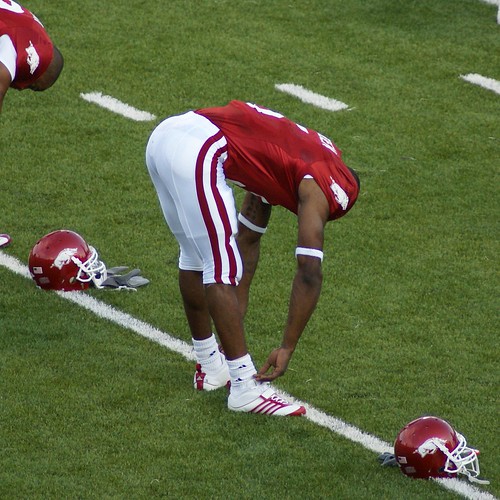
Do this test and you might be able to get further than this guy Pic: ninjapoodles
But How Does It Get So Tight?
There are three ways in which your fascia can become tight.
Trauma
When you injure a muscle and it’s fascia, your body responds by trying to fix it. Fascia is healed with a special collagen fibre. These are laid down in many different directions over the injured point. Your body is basically overcompensating. If the fibres don’t align normally, they can contract and cause a tight spot. Therefore the mobility of the whole fascial unit is compromised.
Chronic Strain
When a tissue is overloaded chronically (long term) your body will produce more collagen. It then accumulates in the fascia that has been overloaded. Same deal as above, thicker tighter fascia leads to many problems. This is probably the number one cause of fascia pain for people. When you sit down at a desk, your Psoas is constantly shortened. When you use the computer, your shoulder is under the same strain everyday. This strain every single day will cause the fascia to react and become tighter, causing trigger points through it and the muscle. Your fascia will change and mould with what you are doing. Incorrect biomechanics or repeat movements will cause your fascia to adapt and take on the abnormal movement patterns and structure.
Immobility
When you are immobile for as little as four weeks, collagen forms on the affected fascia. When immobile there is also an issue of less water binding within the fascia, and the collagen fibres become closer to each other. The flexibility of the fascia then decreases. You see how if you have your leg in a cast for an extended period of time, why you are so stiff when you get out. Same with any injury that causes you to be immobile.
Until Next Time…
If you got your head around all that you are doing well. The most important things to take out from this post is that
- Your fascia is connected right throughout your body.
- It is very adaptable and will change with repeat movements and strain, causing tightness, and therefore trigger points, pain and biomechanical issues.
- If one area isn’t functioning chances are another will be greatly affected, everything is connected.
Take a break and digest this info, but stay tuned….Part 2 ( next thursday) will go through some of the more common problems associated with abnormal fascial function. Part 3 is even better.
Philip says
Looks like the makings of another great series here, Lauren. I love the pic of the front and back fascial lines!
I think it’s important people understand the interconnectedness of the body. We get locked into trying to develop one area and forget the others. This, as you know, can can cause imbalances of all kinds, leading to posture problems and eventually to chronic pain and stiffness. We also tend to feel pain in one area and assume its cause must be in that area, not realizing that a pain in the neck could be (and most likely is) the result of a combination of issues elsewhere in the body.
Thanks again for another informative post.
Cecily T says
I’m with Philip…great post, and looking forward to more info in the next part of the series. I like how you combine a general topic with a specific example that people are able to do right in their homes.
Lauren says
Guys, thanks for the kind words. This is a concept that is important to understand. The body is very much interconnected and a problem in one area will almost always cause or be caused by a problem in another area!
Cheers
joe says
hey good post,
i have a problem with my shins, i really don’t think its shin splints, as i only get pain when walking at a fast pace. the problem is that during the time i walk at a fast pace my shins start to burn and feel really tight, i can only reproduce the pain if i flex my toes towards my shins against a rubber band and hold, the longer i hold the more similar the pain. i don’t get this with running just walking fast, and i don’t have trouble once i stopped. i read a little about compartment syndrome, i think that fits the symptoms.
i was just wondering if this post could be related, i have many sprains on my ankles, and my shins have been bashed about throughout my teens, i blame bmx’s lol.
if you have any thoughts they’d be much appreciated
thank you. joe
Philip says
@Joe – Sounds like it could be compartment syndrome, particularly if you have had trauma to your shins due to the BMX-ing. If that’s the case, being a yoga guy, I’d suggest spending some time in hero’s pose. It’s a great posture for stretching the ankles and connective tissue along the fronts of the legs.
If it’s not compartment syndrome, I might suggest it could be a lack of strength in the tibialis anterior, which is the main muscle on the front of the shin. It crosses the medial side of the ankle joint, which means it is also effected by ankle sprains. To strengthen this, you might try sitting in a rolling chair, flexing the feet, and moving your chair along the floor using your heels. If you experience pain, take a break. If you’re consistent, this may help.
Peace,
Philip
Lauren says
@ Joe
Philip has given you a great answer but I’ll try and back that up. It could be compartment syndrome, which is often characterized but a weakness in the tibialis anterior, where you are saying you are getting pain. it could also just be an overactive tibialis anterior. Either way my suggestion first and foremost would be to see a specialist, this stuff usually happens from bad biomechanics and you may need insoles/ orthotics in your shoes.
In the meantime do a lot of self massage through that area. The exercises Philip suggested are great too. But if they cause you any pain, stop. If it is a weakness in that muscle it may be whats needed. I suggest start with some self massage and icing after pain. Go from there. Definitely see a specialist though it seems as though you may need some help with your shoes!
If it is compartment syndrome it has a lot to do with fascia. Stretch your hip flexors. They are connected and a lot of people find relief this way.
Cheers.
joe says
thanks alot, i try the things you both said, and ill go and see a doctor, see whats what.
Private Idaho says
Great article! I can’t wait for the rest of it. I’ve recently figured out that I have something called Plantars Fasciitis and its killing me. I sit at a computer all day – and have put on lots of weight and now I think the combination of the added strain of the weight and the sedentary lifestyle has caused this fascia to become inflamed. Its awful. I can hardly walk any more. If I sit for more than 15 minutes it becomes painful to walk on it. As it stretches the pain dissipates, so after five minutes of walking I’m ok again.
Can’t wait for part 2!
Lauren says
Hey Private Idaho, I’m glad you liked it. Part 2 and 3 have a specific focus on plantar fascia, so keep an eye out next thursday! It is a very painful condition.
JoLynn Braley says
Hi Lauren,
Very interesting, this reminds me of the “Body Human” exhibit I saw.
I don’t know if that has anything to do with fascia as you’ve described, but I do know that when I’ve had a pain “here” it often is coming from someplace else….over a year ago I could hardly move my right arm and it turned out to be a pinched nerve in my neck. I had to do several sessions at the chiropractor to get that worked out, it was really bad.
I really, though, saw this as going beyond the physical and to the mental/emotional; it started with how I was feeling about my job and manifested in my body.
Thanks for this very informative article, it’s always interesting to learn more about the amazing workings of the physical body.
Lauren says
Thanks for the feedback!
Chris - Shoulder Performance & Rehab says
I thought that I had a basic understanding of most things in the body. I was wrong – I had no idea that the fascia had such an impact throughout the entire physical being.
Great post – I am looking forward to reading parts 2 and 3.
Lauren says
Thanks Chris!
Brandon Waloff says
thanks for this.. i just learned an amazing form of yoga that works with the fascia and PNF breath work to release old fascial patterns. Look up Michaelle Edwards and Yogalign on Kaua’i.. you two would have a lot to discuss!
I will use this site to further educate myself.
Mahalo~ Brandon
Lauren says
Happy to help!
Julie says
I have been having issues with my achillies for some time now, maybe 3/4 years. I didn’t realize how much pain my legs were in until i went to massage therapy and she touched/massaged the inside of my legs from my feet, up my shins and up the insides of my legs… ooouuch – i knew i didn’t like my legs touched but this was incredably painful… i play soccer and workout 3 times a week, but i haven’t been able to go running because of achilles pain… i’m thinking its this fascia stuff… Are there any supplaments i can take to make it more supple and less painful? Please help – i want to start running again…
Julie
Lauren says
Actually you should start using the foam roller and tennis ball to help your pain. Send me an email if you need more information I can help.
Kelly says
Ever since my mother heard the term “compartmentalized muscle syndrome” in an erroneous passage in a 20yr old book, she’s been outright convinced that the “syndrome” was the root cause for all her fascia and muscle pain.
She is 67yrs old and was a hardcore tennis player in her thirties and forties, then switched over to golf in her fifties and sixty, but the damage had already been done.
After finally finding this 3-part “Fascia” article on the net after hours of searching for her so called “syndrome” and not finding anything on the net by the name “compartmentalized muscle syndrome”… only bits and pieces called “compartment syndrome”.
I agree she has signs of compartment syndrome in specific places in her body because of repetitive activities (w/o respite), but the majority of her problems, which is severe pain in virtually every muscle group throughout the body because of poor biomechanics for decades all stemming from her feet.
Ironically she can’t stand having our massage therapist touch her feet because they hurt so bad, so she completely ignores them when they are the root of her problem.
The muscles that overlap, especially in the legs and upper back “stick together” as our currently shared massage therapist states (and has every massage therapist I’ve ever had also stated) because the fascia has become so rigid and bound up over decades that the muscles can no longer slide freely against each other.
Her (and my) staggered gait over the years has lead (no doubt in my mind) to her (and my) shortened hip flexor muscles, strain thought-out the body to muscle, tendon, and ligament dysfunction which cannot be reversed.
We both have to take narcotics to alleviate chronic pain, which is the only thing that does help us both.
Doctors have called our problems “Fibro Myalgia” for decades… and instead of trying to find the root cause of the fascia pain and body wide dysfunction, they have all tried to push Fibro drugs on us, including anti-depressants and non-narcotic neuropathic “pain med” on us, which have NEVER worked.
TRUE… nerve pain is now chronic, but not the root of the problems… it is poor biomechanics that has caused irreversible damage to our entire bodies….
In my case, I have Multiple Sclerosis and both my legs have gone numb and tingling, and most of my left side has also suffered severe sensory deprivation… so my biomechanics have been severely hampered for over 10yr now (since I was 29). I have damaged my feet (broken 6 metatarsals) from stress fractures, ramming my feet into things because I have poor sensory input due to lesions (scars, ) in my spinal cord (Central Nervous System) and in lesions my brain caused by my MS.
Not to mention a car accident that caused mobility issues in my left ankle making my gait even more unstable (for the past 4yrs).
I have Plantar Fibrotosis in both my Plantar Ligaments which cause severe pain and make things even worse for me. The Fibrotosis growths are small but extremely painful for me, even with orthotics.
Orthotics do very little to help me, although they do support my high arches.
The last knuckle on big toe, second and middle toe on my left foot are now all frozen together (totally locked in place) and each toe are now spreading apart from each other to compensate for my staggered gait.
The radiologist who read the X-Ray’s and Nuke Bone scans of my feet and ankles state that these problems are because I’m getting older and it’s normal… BS.
I am in 100% agreement that the majority of my pain throughout my body has been caused by poor & dysfunctional biomechanics, CNS sensory (lack thereof) input, and repeated stress and injury to my feet, etc.
If more doctors would go back to the basics of medicine by diagnosing the root cause of “body-wide dysfunction and pain” (instead of simply prescribing us all BS “Fibro related drugs that do not work for body-wide muscle-skeletal pain then they could focus their energies on trying to solve our feet problems, so that we can all walk with a steady and fluid gait as mother nature intended.
Lauren says
Wow great post! Yes sometimes it is a very simple fix, you don’t always need the fancy stuff. Thanks for the great contribution!
jose galvan jr says
Hi my name is jose galvan
i started having pain behind my leg after falling. i thought i just pulled my hammi so i didnt get it checked out i tjoight it would get better by itself one few months later the pain started to get alot worse and i noticed a baseball lump behind my thigh so i went to the
doctor and found out i tore a four and half inch whole in my fascia behind my thigh i had sergury to try to fix it they couldnt sytetch the fascia back so they put a special mesh to replace the torn fascia.my question to u guys if u can answer it is im still having sever pain in the same place will that pain eventually go away or will i have to live with it for the rest of my life?
Lauren says
What kind of therapy are you undertaking now?
Natasha says
I seem to have tight fascia all over my body I can feel it under my skin all bumpy an when I press on it it’s all crunchy and breaks down but seems to come back 🙁 its on my legs mostly thighs, lower back arms basically all over it’s makin me feel so stiff all the time and tired what can I do?
Lauren says
Have you tried foam rolling and using the tennis ball yet? Let me know what you have been doing so far and we’ll work from there.
Natasha says
Hey I just realised you had wrote back, thanks, yea tried foam rolling but it didn’t seem to be helping much or it could be because I was to impatient an didn’t do it long enough , haven’t tried the tennis ball yet, started getting deep tissue massages and only been twice so far after first time I did feel tension was releieved but now I feel I’m back to square one its so depressing when I have a 1 year old to look after
Lauren says
Ok Natasha, it might be a good idea to try just before going to bed. That way you have a little bit of peace and ensure you get it done. If you are using the tennis ball you can even do it in bed just before falling asleep. This stuff will really help you, but you need to schedule some time for it!
Let me know how you go!
Tony Stubblefield says
Hello I am dealing with adhesions and fascia issues threw my hamstrings,adductor too the left knee and have done much much therapy but things are still major tight threw my hamstrings and upper hamstrings below my buttocks and I do get pain that radiates from tight hamstring which also a M.R.I. showed findings of mild scar tissue and a mild Lipoma knot that’s been in my tight hamstring area now for over 1 year now could this Lipoma also be pressing up on fascia issues or nerve issues thanks.tried everything for this fascia I go and see a plastic surgeon soon for the Lipmoa knot inside my hamstring ,how else can fascia be teated if therapy not helping me ?