If you are suffering from hip bursitis and are looking for a way to reduce your pain at home, check out my Ultimate Self Massage Guide. It shows you how to use a tennis ball and foam roller to get rid of your pain at home.
Although the hip joint is relatively strong, it is still prone to certain types of injuries. It is not uncommon for people to suffer from hip bursitis. This is a condition in which the tissue around the bursa in the hip joint becomes inflamed and aggravated, and causes pain in the hip. A bursa is a small sac, which is filled with fluid, and will act to cushion the movements of a joint. The bursa of the hip lies in between the attachment of the gluteal muscles, and the head of the femur, which is known as the greater trochanter. As you can imagine, considering where the bursa sits, tight or aggravated gluteal muscle are often a cause of hip bursitis.
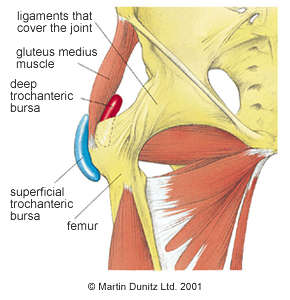 The bum muscles are used for moving the hip primarily, and they also help to stabilize the pelvis during activity. When the glute muscles contract, you often place quite a lot of pressure and friction onto the bursa of the hip. If the forces are too much, or there is a lot of repetition of the same movement, then you may be at risk of developing hip bursitis. People with bad hip biomechanics are at more risk. Can also be associated with a hip labral tear.
Here are some of the common causes of hip bursitis.
- Stiffness in the hip joint
- Muscle tightness in the hip
- Bad biomechanics
- Excessive training or overload
- Weakness in the hamstrings or gluteal muscle
Fortunately there are treatments and hip bursitis exercises available to help reduce the pain significantly.
Hip Bursitis Treatment
Until the patient is pain free, is is better to stop any exercise that aggravates it. Once the pain has eased, they can gradually return to previous activity. This will ensure that there is no further tissue damage or aggravation of the bursa. Rest and ice are important initially to help calm the bursa, and anti inflammatory medicine may also help to reduce the swelling, inflammation and pain in the area.
Hip Bursitis Exercises
Hip bursitis is caused by friction coming from the gluteal muscles. Logically, you need to ensure that this area is both loose, and strong in order to relieve the pressure.
The first thing you need to concentrate on are stretches, as you don’t want to aggravate the area. Here is one example of a good glute stretch.
You then want to undergo a gradual strength program for the glutes and hamstrings, as you need to ensure these are strong to help relieve the pressure places on the bursa during activity. Bad biomechanics is one of the number one causes of hip bursitis. Check out some great bum exercises and hamstring exercises.
Student says
Hi, just a comment on the “glute stretch”. This is not a glute stretch, but a Piriformis stretch. While this likely will aid in Trochanteric Bursitis and possibly Ischial/Gluteal Bursitis, I just thought a clarification was warranted.
Gluteus Maximus is an external rotator. Gluteus Medius is primarily an external rotator. In your stretch you are externally rotating the hip which is slackening the Glute Max and posterior Glut Med.
To stretch the Glute Max, place your hands in front of your knee and pull it up toward the opposite shoulder while keeping your pelvis and hips centered on the ground.
Thanks for the article, though.
vicki richardson says
i had a partial hip replacement and was told i had burisitis in my hip. i have tried and ice rest and physical therapy. nothing is working. do you have any stretches that don’t compromise my hip replacement.
Lauren says
Vicki sorry for the late reply. How is your therapy going now?
Website says
Amazing Webpage, Keep up the very good work. Regards.
Senaida says
Hey! I know this is kinda off topic however , I’d figured I’d ask.
Would you be interested in trading links or maybe guest authoring a blog post or vice-versa?
My website covers a lot of the same subjects as yours and I think we could greatly benefit from each
other. If you’re interested feel free to shoot me an e-mail. I look forward to hearing from you! Great blog by the way!
true nutrition discount says
Hey there, You’ve done a great job. I will certainly digg it and personally
recommend to my friends. I’m sure they will be benefited from this web site.