The movement and consequent function of the pelvis plays a big role in your ability to have correct posture when exercising and performing every day activities. Getting your pelvis moving correctly will have a big influence over your ability to lift, your injury risk, your health, and the way you look. Correct pelvic posture is important, make sure you get yours right.
The Tilts
The two movements we are concerned with are the Anterior Tilt, and the Posterior Tilt. With muscles imbalances the pelvis will tilt into either one of these directions.
-The anterior tilt is when the pelvis is tilted to the front. Consequently you are creating a massive lordosis in your lower back, arching it out.
-The posterior tilt is when your pelvis is tilted to the back, and your lower back is flattening out.
Both of these pelvis abnormalities have implications. They come about through flawed posture throughout the day, bad lifting technique and repetitive movements. Basically, if you are doing something over and over, putting repetitive strain on your body, it will adapt.
When you have an anterior tilt your glutes are in a bad position and won’t fire as well. As a consequence your hamstrings and groins can become overworked. You can also put extensive stress through your lower back, as you are trying to produce hip extension, but your glutes can’t do it.
If you are in a constant posterior tilt, your lower back is always flattened out. This results in constant lumbar flexion, which isn’t great for your lower back, especially when lifting. The main problems and pain that is experienced from both these tilts is in the lower back. Excessive strain is put through it either way. For further information on bulging disc treatment check out the article I wrote.
Muscles Affecting the Hip
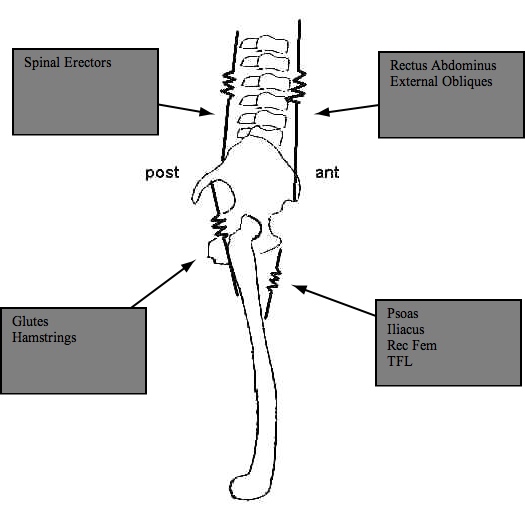
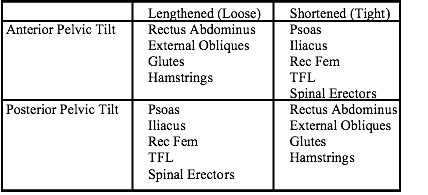
This picture illustrates how the anterior and posterior muscles can pull and affect the hip positioning. The table below lists which of these muscles are tight and which are loose in each case.
Pic: moon.ouhsc.com

What’s Tight and What’s Loose?
Look out for Part 2, where you will learn how to treat both posterior and anterior tilts.
MizFit says
I havent thought about these in ages!
do you do them often?
M.
Lauren says
Hey Mizfit
Not quite understanding? Do I do what often?
I tend to be in more of an anterior tilt when my glutes stop firing. I do the exercises that will be in Part 2 very often!
Cheers!!
yemu says
do you think that it’s possible to have anterior pelvic titl and tight hamstrings at the same time? because i think i have such condition 😉 i have “protruding guts” and a little “monkey butt” but at the same time i’m not flexible in my hips (i think mainly because of hamstrings
best regards
y
Lauren says
Yep. your hamstrings are probably tight because of your anterior tilt. For eg. if you have tight hip flexors, and you have an anterior tilt because of them, then your hamstrings are constantly on stretch and become tight, or feel like they are tight, even if they aren’t directly the problem.
hope that helps!
yemu says
thanks for your answer!
now i follow stronglifs program and stretch alot. but i’m not sure if i should stretch my hamstrings or not. well streched hamstrings are crucial for safe squat technique…
do i think right that i shoul both stretch and strenghten my “lower posterior chain” and strenghten my abs to fight the lordosis?
Lauren says
spot on, do all of it. Also, target your hip flexors when stretching. Stretching your hamstrings certainly isn’t going to hurt anything. I think they are probably tight from your lordosis/anterior tilt, although stretching them won’t fix the core problem, it will help supplement the rest.
Cheers.
Jason says
I hope part two comes out soon!
Michael says
Hi Lauren – great site. Just reading some of the people’s comments here means I now realise I’m not alone! I’ve always had people say my bum is rock hard and also larger than most. But I’ve never understood why my hamstrings we so short and tight, my low back very arched (thus giving me a protuding tummy), lower back muscles very strong but abs are always useless.
I think I know understand what I have and with your Part 2, how to go about doing something about it!
I also liked your volleyball stretches, and am going to do what you are making your housemate do – it can only be good afterall…
Thanks again Lauren,
Michael, London
Pat says
Very informative! Thanks!
Glenn says
I have anterior tilt on L side & posterior tilt on L side – assume one is going out in sympathy with the other?
Physios I’ve seen get confused in the treating of both sides at same time.
How should I treat it, treat each side individually with the relevant stretches & exercises.
This stuff really hurts & stuffs work & quality of life
Anybody got suggestions or a program?
Glenn says
Sorry – Anteriorr tilt on R side & Posterior tilt on L side (Typo)
Lauren says
OK, in all seriousness. I have no idea. I would treat them each side by itself, but given I am not a practitioner, I’m going out on a limb here to say you have something higher up, or lower down thats the problem…
What happens when you do myofascial release for each side?
Glenn says
I can release the hip rotation, but it always comes back. Cannot find someone to provide a concise program, had it for a few years & was always trreated for back problems as back would lock & get tight. Kept me off work for 12 mths. problem started from siting & had coccyx removed in 2003 (no help) – stand at work these days less pain than sitting. Sitting absolute stuffs things up. chiro I visit treated me for hip rotation & back pain disappeared almost immediately. that’s how I know it is the hips. back is secondary. Your descriptions for anterior tilt are exactly what my body does on the R side. when hips are aligned, back is ok. NOTE; right hip is always higher than L. Have had orthotics – no help. I know it is from an imbalance somewhere, I can feel it in the hips/butt/legs. but it is so complicated & the iternet is confusing as they do not deal with both problems at the same time.
I am thinking of doing isolated exercise for each side, that focus on the reverse (eg PSOAS (R) Stretch & (L) strengthen). squats, bridges etc, only reinforce the already overactive side & visa vi.
I have good techniques to reverse the hip rotation by twist hips in reverse direction, works well. However it never holds for long.
Understand you are not a practioner, but I have spent thousands on them over the last 10 years & they are of no help. Frankly you make more sense. I would appreciate your guidance please.
Lauren says
Alrighty. To be honest I would treat it at the start with some bi lateral exercises, chances are you have some general imbalances, and doing some basic stuff correctly won’t hurt. We’ll try to even your body out slowly, and getting the imbalances right early will ensure a better base. Try this out, but the moment you have serious pain, stop…get back to me and we’ll try something else. It’s possible the elevated hip is causing problems too.
Definitely focus on releasing the Psoas on both sides, check out my tennis ball therapy articles, and you will find how to release it with a tennis ball. Get stuck into ALL of this work, try all the places I mention, you may just come across something, and it is likely you have tight places all over the shop. Also focus on your ITB.
It is most likely a tight psoas that is causing the one hip higher than the other, but check out your quadratus lumborum as well, google it to find what muscle it is. Best not to stretch it, but be aware of it, massage is the best for this, or some form of release,if you fix other discrepancies, this will usually loosen itself.
Do a lot of bridges. The exercise you see in this post I wrote, at the bottom. Like I said we will start simple to know what works. This is good starting point.
http://stronglifts.com/the-psoas-is-it-killing-your-back/
For now, I would start here, loosen then Psoas on BOTH sides, strengthen the glutes on BOTH sides, explore your whole body using the tennis ball, and let me know asap what you find from that. If you have extra tight areas or more pain in some, I will give you a few more stretches and exercises.
Start basic, and we’ll work up.
Keep in touch.
Dean says
Hi
You said for APT to do crunches and sit-up variations but isn’t that just going to tighten the hip flexors even more? I thought the hip flexors were already super tight?